Hello. My name is Kimberly, and I’ve been living with generalized myasthenia gravis, or gMG, for several years. Today, I want to talk to you about how gMG affects your body. And later, we will talk about a treatment designed to help reduce the harmful antibodies that cause gMG symptoms by blocking FcRn receptors. If you’re living with gMG, you know it’s an autoimmune condition that causes muscle weakness, sometimes making even simple tasks feel challenging.
All of our bodies produce a protein known as an IgG, or immunoglobulin antibody. These antibodies protect us from outside viruses and bacteria that can make us sick. But in a person living with gMG, the body may also create harmful IgG antibodies. From here on, we’ll refer to them as “harmful IgG.” These antibodies can mistakenly target the receptors on your muscles, interrupting the nerve signals that tell your muscles to move.
When signals between your nerves and muscles are interrupted, it can cause gMG symptoms. These can include muscle weakness and muscle fatigue, which can make everyday tasks more difficult. To really understand how gMG impacts the body, let’s explore what’s happening on the inside, together.
Great, you’re here! Now, let’s take a closer look at what’s happening inside people living with gMG. As I mentioned earlier, the normal function of IgG is to help the body fight off invading viruses and bacteria. But in gMG, there can be harmful IgG that target receptors at a place called the neuromuscular junction – the site where nerves and muscles meet.
At the neuromuscular junction, nerve cells send signals to muscle cells. These signals act as instructions that help tell muscles to move. The signals are received by the receptors on muscle cells. Harmful IgG can attach to and block those important receptors, preventing signals from reaching your muscles to tell them to move. This could result in gMG symptoms. The main receptor that receives the signals from the nerves is called the acetylcholine receptor, or AChR. People with harmful IgG that target this receptor are known to have anti-AChR antibody-positive gMG.
Another receptor involved at the neuromuscular junction is the MuSK receptor. It’s less common for people living with gMG to have harmful IgG that target MuSK. People with harmful IgG that target this receptor are known to have anti-MuSK antibody-positive gMG. While harmful IgG are key players in gMG, another receptor is equally important to understand. It’s called the neonatal fragment crystallizable receptor – also known as F-C-R-N – and it controls how long IgG stays in the body.
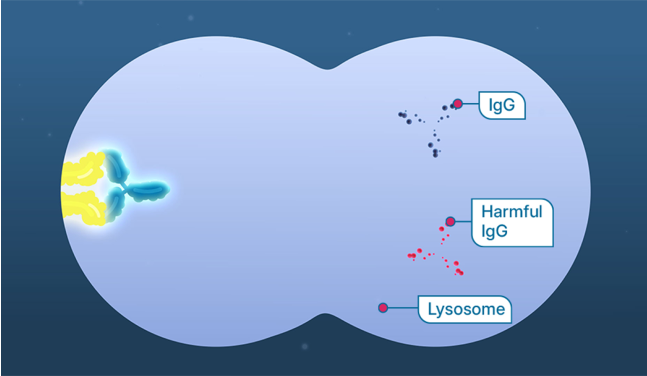
FcRn is a protein in your body that is responsible for recycling IgG, and it increases how long IgG stays within the body. Part of the lifecycle of IgG includes a process in which they are broken down, or degraded, inside the cell.
FcRn protects IgG from being degraded and recycles them back into the body. However, FcRn doesn’t have the ability to recognize the difference between helpful and harmful IgG. This extends the life of IgG, including harmful IgG, meaning both helpful and harmful IgG stay in your body longer.
When harmful IgG are recycled and kept in your body, they can continue to interfere with the communication between your nerves and muscles. This can continue to lead to gMG symptoms. We’ve now got a good idea of what’s happening inside the body when it comes to gMG disease activity. Now, let’s learn about a treatment that might be able to help.
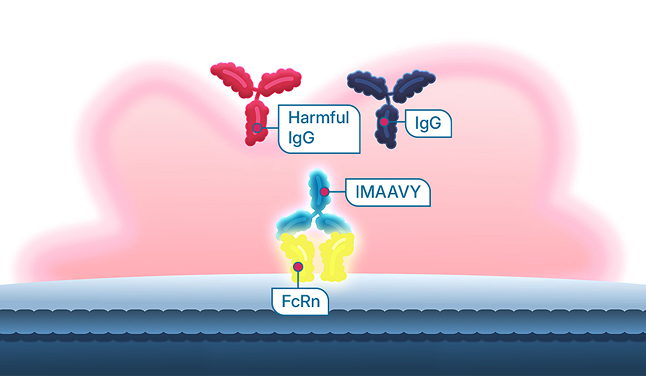
Still with me? Great. It’s time to learn about a type of treatment that disrupts the binding of IgG to FcRn. This treatment is called an FcRn blocker. How does it work? It binds to FcRn, which can help prevent some IgG from binding to FcRn. IgG that do not bind to FcRn are broken down instead of recycled back into the body.
Next, and you might have guessed it already, lower levels of IgG mean lower levels of harmful IgG targeting AChR or MuSK receptors on muscle cells. This can lead to improvement in gMG symptoms.
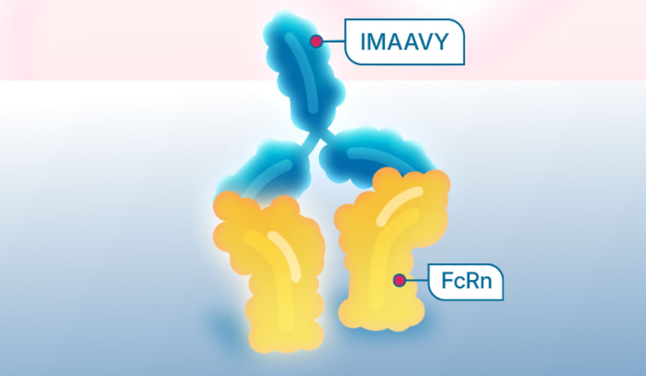
IMAAVY is designed to reduce harmful IgG antibodies, including anti-AChR and anti-MuSK, by binding and blocking FcRn receptors. As we have learned, these harmful IgG antibodies can cause gMG symptoms. With IMAAVY binding and blocking FcRn receptors, there are lower amounts of harmful IgG, including anti-AChR and anti-MuSK, which can result in fewer interruptions between the nerves and muscles.
And fewer interruptions between nerves and muscles may mean that daily activities affected by gMG can become easier for you. In a clinical study, the most common side effects with IMAAVY included infection in parts of your body that you use for breathing (known as respiratory tract infection), swelling in your hands, ankles, or feet (known as peripheral edema), and muscle spasms.
So, if you’re looking for a treatment to help manage your gMG symptoms, ask your healthcare provider about IMAAVY today!
What is IMAAVY (nipocalimab)?
IMAAVY is a prescription medicine used to treat adults and children 12 years of age and older with a disease called generalized myasthenia gravis (gMG) who are anti-acetylcholine receptor (AChR) or anti-muscle-specific tyrosine kinase (MuSK) antibody positive.
It is not known if IMAAVY is safe and effective in children under 12 years of age.
IMPORTANT SAFETY INFORMATION
What is the most important information I should know about IMAAVY®?
IMAAVY® is a prescription medicine that may cause serious side effects, including:
- Infections are a common side effect of IMAAVY® that can be serious. Receiving IMAAVY® may increase your risk of infection. Tell your healthcare provider right away if you have any of the following infection symptoms:
- fever
- chills
- shivering
- cough
- sore throat
- fever blisters
- burning when you urinate
- Allergic (hypersensitivity) reactions may happen during or up to a few weeks after your IMAAVY® infusion. Get emergency medical help right away if you get any of these symptoms during or after your IMAAVY® infusion:
- a swollen face, lips, mouth,
tongue, or throat - difficulty swallowing or breathing
- itchy rash (hives)
- chest pain or tightness
- Infusion-related reactions are possible. Tell your healthcare provider right away if you get any of these symptoms during or a few days after your IMAAVY® infusion:
- headache
- rash
- nausea
- fatigue
- dizziness
- chills
- flu-like symptoms
- redness of skin
Do not receive IMAAVY® if you have a severe allergic reaction to nipocalimab-aahu or any of the ingredients in IMAAVY®. Reactions have included angioedema and anaphylaxis.
Before using IMAAVY®, tell your healthcare provider about all of your medical conditions, including if you:
- ever had an allergic reaction to IMAAVY®.
- have or had any recent infections or symptoms of infection.
- have recently received or are scheduled to receive an immunization (vaccine). People who take IMAAVY® should not receive live vaccines.
- are pregnant, plan to become pregnant, or are breastfeeding. It is not known whether IMAAVY® will harm your baby.
Pregnancy Safety Study. There is a pregnancy safety study for IMAAVY® if IMAAVY® is given during pregnancy or you become pregnant while receiving IMAAVY®. Your healthcare provider should report IMAAVY® exposure by contacting Janssen at 1-800-526-7736 or www.IMAAVY.com.
Tell your healthcare provider about all the medicines you take, including prescription and over-the-counter medicines, vitamins, and herbal supplements.
What are the possible side effects of IMAAVY®?
IMAAVY® may cause serious side effects. See “What is the most important information I should know about IMAAVY®?”
The most common side effects of IMAAVY® include: respiratory tract infection, peripheral edema (swelling in your hands, ankles, or feet), and muscle spasms.
These are not all the possible side effects of IMAAVY®. Call your doctor for medical advice about side effects. You are encouraged to report negative side effects of prescription drugs to the FDA. Visit www.fda.gov/medwatch, or call 1-800-FDA-1088.
Please see the full Prescribing Information and Medication Guide for IMAAVY® and discuss any questions you have with your doctor.
Dosage Form and Strengths: IMAAVY® is supplied as a 300 mg/1.62 mL and a 1,200 mg/6.5 mL (185 mg/mL) single-dose vial per carton for intravenous injection.
cp-509746v1